43% human, 57% germs |
 |
More than half your body is not human
By James Gallagher Presenter,The Second Genome, BBC Radio 4
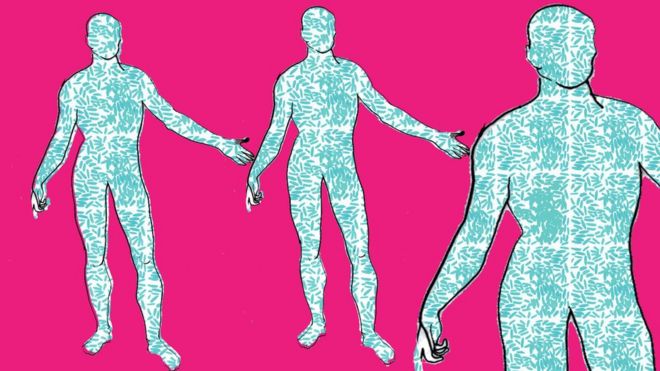 |
Human cells make up only 43% of the body's total cell count.The rest are microscopic colonists. Understanding this hidden half of ourselves - our microbiome - is rapidly transforming understanding of diseases from allergy to Parkinson's. No matter how well you wash, nearly every nook and cranny of your body is covered in microscopic creatures. This includes bacteria, viruses, fungi and archaea (organisms originally misclassified as bacteria). The greatest concentration of this microscopic life is in the dark murky depths of our oxygen-deprived bowels. |
"They are essential to your health," says Prof Ruth Ley, the director of the department of microbiome science at the Max Planck Institute, "your body isn't just you".
Originally it was thought our cells were outnumbered 10 to one.
"That's been refined much closer to one-to-one, so the current estimate is you're about 43% human if you're counting up all the cells," he says.
But genetically we're even more outgunned.
The human genome - the full set of genetic instructions for a human being - is made up of 20,000 instructions called genes.
But add all the genes in our microbiome together and the figure comes out between two and 20 million microbial genes.
Prof Sarkis Mazmanian, a microbiologist from Caltech, argues: "We don't have just one genome, the genes of our microbiome present essentially a second genome which augment the activity of our own.
"What makes us human is, in my opinion, the combination of our own DNA, plus the DNA of our gut microbes."
Science is rapidly uncovering the role the microbiome plays in digestion, regulating the immune system, protecting against disease and manufacturing vital vitamins.
Prof Knight said: "We're finding ways that these tiny creatures totally transform our health in ways we never imagined until recently."
Antibiotics and vaccines have been the weapons unleashed against the likes of smallpox, Mycobacterium tuberculosis or MRSA.
That's been a good thing and has saved large numbers of lives.
But some researchers are concerned that our assault on the bad guys has done untold damage to our "good bacteria".
Prof Ley told me: "We have over the past 50 years done a terrific job of eliminating infectious disease.
"But we have seen an enormous and terrifying increase in autoimmune disease and in allergy.
The microbiome is also being linked to diseases including inflammatory bowel disease, Parkinson's, whether cancer drugs work and even depression and autism.
Prof Knight says: "We were able to show that if you take lean and obese humans and take their faeces and transplant the bacteria into mice you can make the mouse thinner or fatter depending on whose microbiome it got."
Topping up obese with lean bacteria also helped the mice lose weight.
"This is pretty amazing right, but the question now is will this be translatable to humans"
This is the big hope for the field, that microbes could be a new form of medicine. It is known as using "bugs as drugs".
"In a diseased state there could be bugs missing, for example, the concept is to reintroduce those."
Dr Lawley says there's growing evidence that repairing someone's microbiome "can actually lead to remission" in diseases such as ulcerative colitis, a type of inflammatory bowel disease.
Illustrations: Katie Horwich

